
A range drawn to make the map make sense
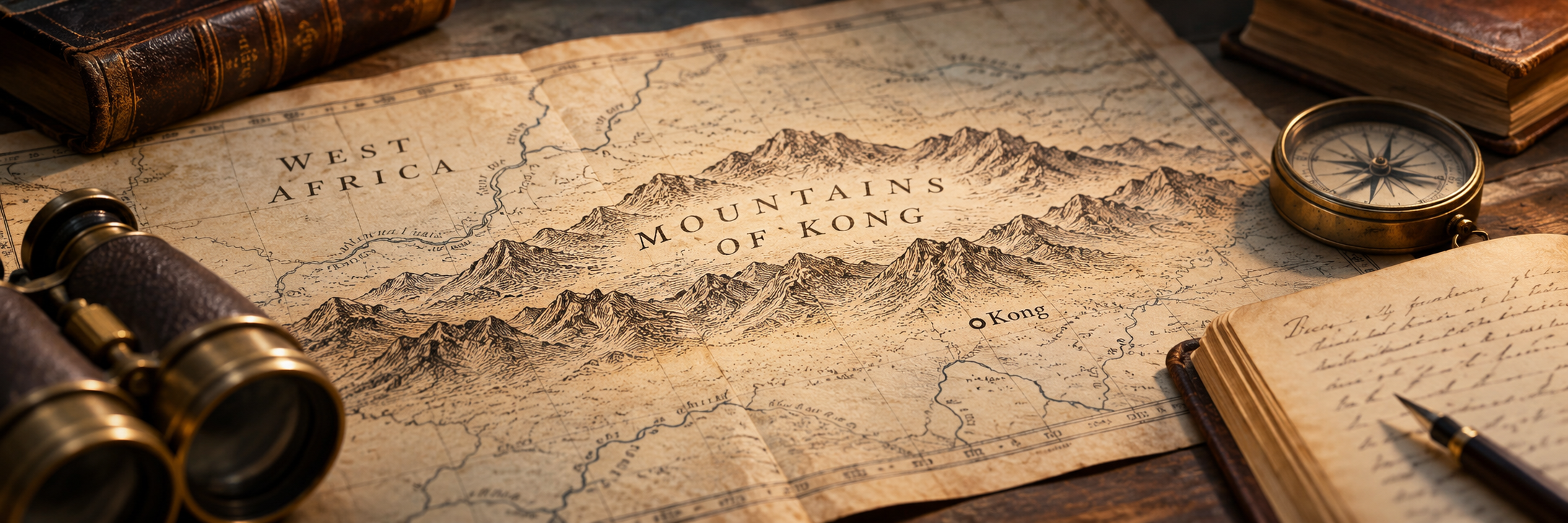
In 1798 the English geographer James Rennell drew a mountain range across West Africa. He had never been there. He was working from the notes of Mungo Park, a Scottish explorer who, on his hunt for the Niger, had looked south, seen hills on the horizon and been told by locals that they belonged to a kingdom called Kong. Rennell also had a theory about which way the Niger flowed, and a long east-to-west range made that theory work rather nicely. So he drew one.
Rennell was no hack. He had surveyed Bengal for the East India Company and was known for being meticulous, which is exactly why everyone believed him. Other mapmakers copied the range within a few years. One map in 1805 ran it clean across the continent to meet the Mountains of the Moon. The historians Thomas Bassett and Philip Porter later counted forty published maps showing the Mountains of Kong between 1798 and 1892.
Nobody needed to lie. Each mapmaker trusted the one before, and every new map made the next one look better sourced. Forty maps feels like overwhelming evidence until you notice it is mostly one uncertain idea, copied forty times.
In 1888 a French officer named Louis-Gustave Binger walked to Kong. He found a town with mosques in it. He did not find any mountains. Even then the range took its time leaving. Bartholomew's Oxford Advanced Atlas still listed it in the index in 1928, coordinates and all.
It is hard to read that story now without thinking about AI.
Everyone's map, nobody's terrain
AI is mostly described by people with very good reasons to describe it generously. Model companies talk up reasoning. Creative platforms show off the one clip that came out perfectly. Agent startups demo workflows running end to end. Consultants explain how fast it is all changing, and we are one of them, so apply the appropriate discount. Early adopters, quite reasonably, want to be seen as early.
Most of what they say is true, and that is what makes it slippery. The distortion happens in the retelling, the same way Park's hills became Rennell's range. A demo where an agent completes a task becomes "that task is automated". Someone writes up one business doing it, and that becomes "businesses are automating it". By the time it lands in a board paper, a capability that still needs a person watching it, nudging it and re-running it three times has become something the organisation is apparently behind on.
Most people in that chain have not invented anything. They have simply passed on the interesting part and quietly dropped the scaffolding around it.
Nobody posts the scaffolding
The people pushing hardest with these tools are, by definition, working at the edge of what the tools reliably do. They structure inputs carefully, fix outputs, try four approaches and slowly learn which steps still need a human. That is what good early adoption looks like. It also makes terrible content.
So what travels is the result. The image that finally worked on attempt thirty-one. The app built in an afternoon, while the week of fixing it afterwards never gets a post. The agent that finished the job. Nobody shares the twenty minutes spent tidying up after the thing that was supposedly automated, partly because it is dull and partly because it slightly ruins the story.
From the outside, that produces a very particular kind of anxiety. You try the tools and they are brilliant on Tuesday and baffling on Wednesday, while every public example seems to just work. The sensible conclusion is that everyone else has cracked it and you have not. Executives start to feel behind. Staff assume they are using the tools wrong. Quite often they are standing in almost exactly the same spot as everyone else, looking at the same mountains on the same map.
Capability isn't reliability
Spend a week with most of these systems and the distance between the announcement and the experience becomes obvious. A model will give you a sharp strategic observation and then, two messages later, forget something you told it at the start. An image platform will produce something remarkable first go, then fail eleven times at "make the jacket blue". An agent will work through a long, fiddly sequence and stop dead at a pop-up a person would barely register.
None of that means AI is overhyped. The capability is real and it is improving quickly. The problem is that the market tends to map the best-known capability as though it describes the everyday terrain. It does not. "It can do this" and "it does this every time" are very different claims. Say the first one often enough, though, and people start hearing the second, and the imagined baseline moves much faster than the real one.
That has consequences. A leadership team that thinks its competitors have automated what is actually being heavily supervised will measure itself against a business that does not exist. Staff told over and over that AI can already do their job will blame themselves when it cannot. The mountain is not there, but people are still planning their route around it.
Go and walk to Kong
Kong came off the maps because someone went and looked. Binger did not argue with the cartographers or write a stern letter to a geographical society. He walked there and wrote down what he saw.
That is the habit worth building for anyone making AI decisions now, and it does not require cynicism. When someone says a process is automated, ask what still surrounds it: who checks the output, how often it gets re-run, what happens on a bad day. When a platform shows off a new capability, try it on your messy version of the problem, not their clean one. When a company says it has transformed a workflow, ask to see the ordinary Tuesday version rather than the launch-day one.
AI is moving fast enough without businesses inventing extra pressure for themselves. There is no advantage in believing your competitors are further ahead just because their highlights reel looks better than your everyday footage. The benchmark worth having is what you can get the technology to do, again and again, inside your own organisation, with your own data and your own people.
For ninety-odd years the Mountains of Kong sat on every respectable map, and that made them feel real. It did not make them real. Worth remembering the next time everyone suddenly agrees there is a mountain you need to climb.