
The complaint
The creative services industry has settled on its critique of AI, and the word is bland. The machine is beige. It produces competent, forgettable, middle-of-the-road work, and everyone from the awards stage to the trade press has lined up to say so. They’re right, as far as it goes. AI is trained on the average of everything the industry has ever published, so its default output is, almost by definition, the middle of the market.
But let’s be honest about the comparison being made, because there’s something a little rich in an industry holding up blandness as the machine’s failing. Average advertising is not a new invention. It has been the industry’s main product for as long as the industry has existed. For every campaign that enters the cultural memory there are ten thousand that pass through it without leaving a mark, made by professionals, approved by committees, paid for in full.
The dishonest benchmark
When the industry wants to show what AI can’t do, it reaches for the top shelf. AI could never make Dumb Ways to Die. It could never make The Best Job in the World, or the Carlton Draught Big Ad. All true. Those campaigns came from somewhere machines don’t go, a strange, brave, human place, and it’s no accident that list rolls off an Australian tongue, because this country has produced more than its share of them.
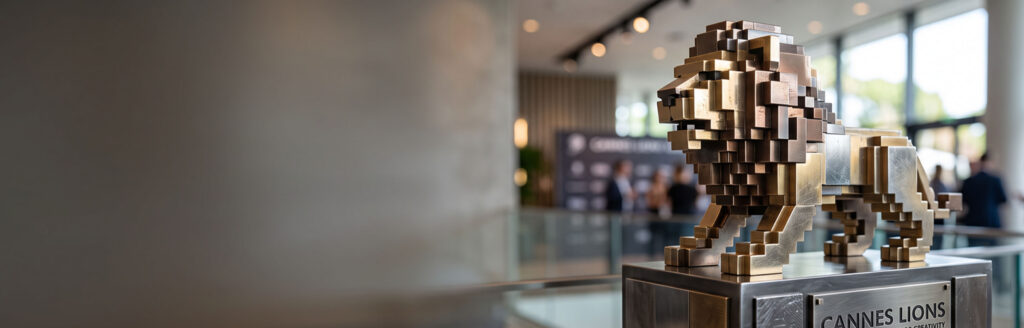
But most of the industry can’t pull those off either. That’s what makes them famous. Pointing at the top one per cent of the world’s creative output and declaring that AI can’t reach it is not a defence of the industry. It’s an evasion, because the honest comparison is between AI and the other ninety-nine per cent, and on that ground the contest is uncomfortably close. AI can’t win a Cannes Lion today. It almost certainly will before long. And that still isn’t the point.
The proving ground problem
Here’s the point. The people who made those one-per-cent campaigns did not arrive fully formed. They started average. They learnt the craft on the unglamorous ninety-nine per cent, the retail catalogues, the radio scripts, the product ads nobody remembers, and somewhere in those years of ordinary work they developed the judgement that eventually produced the extraordinary. The forgettable middle of the market wasn’t just output. It was the apprenticeship. It was where average creatives got the reps that turned a few of them into great ones.
So the thing to worry about isn’t AI winning awards. It’s AI absorbing the ninety-nine per cent, doing the ordinary work competently and cheaply, and taking the proving ground with it. If the machine handles every unremarkable brief, where does the next generation of remarkable people come from? You cannot train judgement on work you never did. An industry that keeps its top one per cent but loses the ladder that produced them has about one generation of greatness left in stock.
We’ve been here before
Is this new? Not really. Performance marketing started the same erosion years before AI arrived, with its own version of the argument: that lots of cheap variation beats a good idea, that testing a hundred mediocre executions is smarter than backing one brave one. The craft of the idea got squeezed then too, and for a while the spreadsheets appeared to be winning.
The creative industry has been fighting back with evidence rather than sentiment, and the evidence is good. James Hurman’s work with Tracksuit is a fine example of the effort, patiently teaching the market that brand thinking pays. Their research with TikTok found that brands with high awareness convert at nearly three times the rate of brands without it, and that a brand known by four people in ten is over forty per cent more efficient at performance marketing than one known by three in ten. The great idea, it turns out, was never a luxury. It was the thing making the performance budget work.
Keep buying the thinking
So the hope, and it is partly a hope, is that the market listens and acts. That businesses keep looking for great ideas and paying for creative thinking, even when, especially when, that thinking then gets executed through the AI studio. There’s no contradiction in that pairing. A genuinely original idea, produced at AI speed and AI scale, is the best of both worlds, and it’s exactly how we’d argue the tools should be used. The idea is the differentiation. The machine is the amplifier. Run them in that order and you get distinctive work at a volume no agency of humans could match.
Run them in the other order, brief the machine and hope, and you get the beige the industry is complaining about, at a scale the industry never managed. But the deeper cost won’t show up in this year’s campaigns. It will show up in a decade, when we go looking for the people who can tell a brave idea from a safe one and find we stopped growing them. The creative muscle only exists because ordinary work exercised it. Lose that, and it will be a genuinely sad day for marketing, not because the machines got good, but because we forgot how people did.